
Written by Susan Li・Edited by Puspadewi Adiseputra & Wakaba Saito
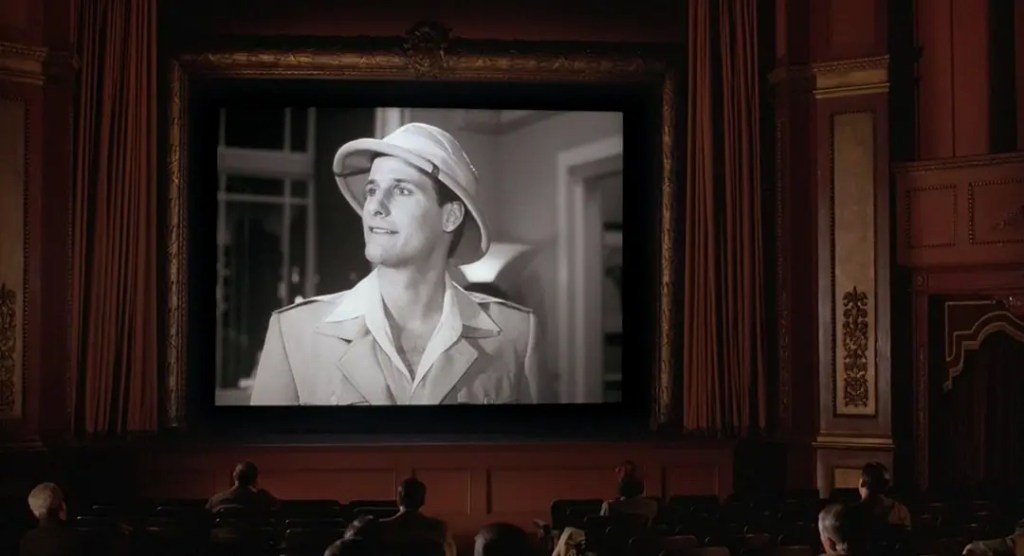
The story of the purple rose of Cairo comes from an old legend that a pharaoh gave a purple rose to a queen, which later flourished in her tomb. Tom Baxter is on a quest to find the legendary purple rose. The film released in theaters, The Purple Rose of Cairo, is based on this legend, and the real-world film, written and directed by Woody Allen and released in 1985, starring Mia Farrow and Jeff Daniels, is also called THE PURPLE ROSE OF CAIRO.
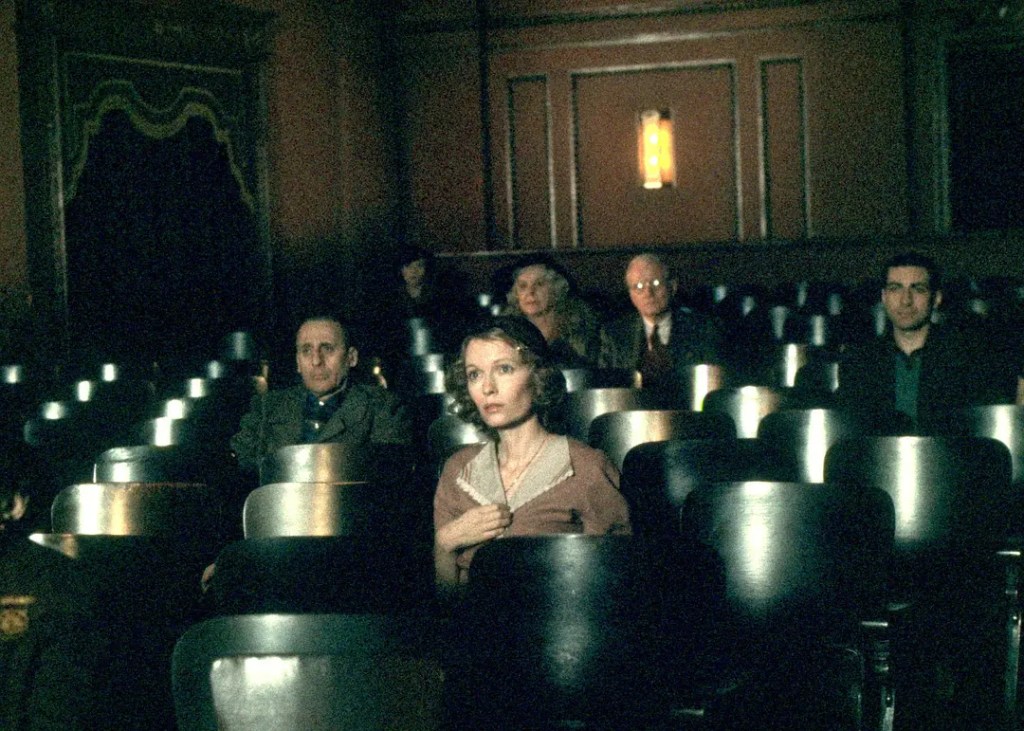
Cecilia lives in the United States during the Great Depression, originally working as a waitress in a small restaurant to maintain a meager income but was fired. Her husband is a rude and uninteresting man. Cecilia endures the hopelessness of real life and at the same time puts her life’s fantasies and hopes in the film, indulging in the illusionary dreams that the film has conjured up. On her fifth viewing of The Purple Rose of Cairo, she notices an important character in the film, (let’s use Tom’s words) Tom Baxter of the Chicago Baxters, explorer, poet, and adventurer, is suddenly staring at the viewers and trying to start a conversation. After a few confirmations, Cecilia is surprised to find that Tom is talking to her. Then to everyone’s shock, Tom walks out of the black-and-white screen and into the real-world theater that Cecilia is in. Over the course of time Tom falls in love with Cecilia and even invites her back to his original, black-and-white film world.
“I hate reality. And, you know, unfortunately, it’s the only place where we can get a good steak dinner.” – Woody Allen

Rather than Cecilia’s story, this film is more like Woody Allen’s own attitude toward reality. He spent his childhood escaping to the cinema and letting time slip away while the projector turned. Woody Allen probably discovered early on that cinema draws the viewer into many imaginary mental worlds, while at the same time, reality reminds us of its existence all the time. THE PURPLE ROSE OF CAIRO also displays a very Woody Allen-ish construction of the virtual within the real and the hidden real within the unreal.
The film’s most straightforward blurring of the real and the fictional is in Tom’s physical leap from the virtual to the real, where he can meet real people and touch them. As a ‘person’, he is real. However, there are still some obvious boundaries between reality and the virtual, such as the fact that Tom’s money is fake for the stage, or that the car doesn’t start without the key as he thought it would. Everything that happens outside of the plot is foreign to Tom.
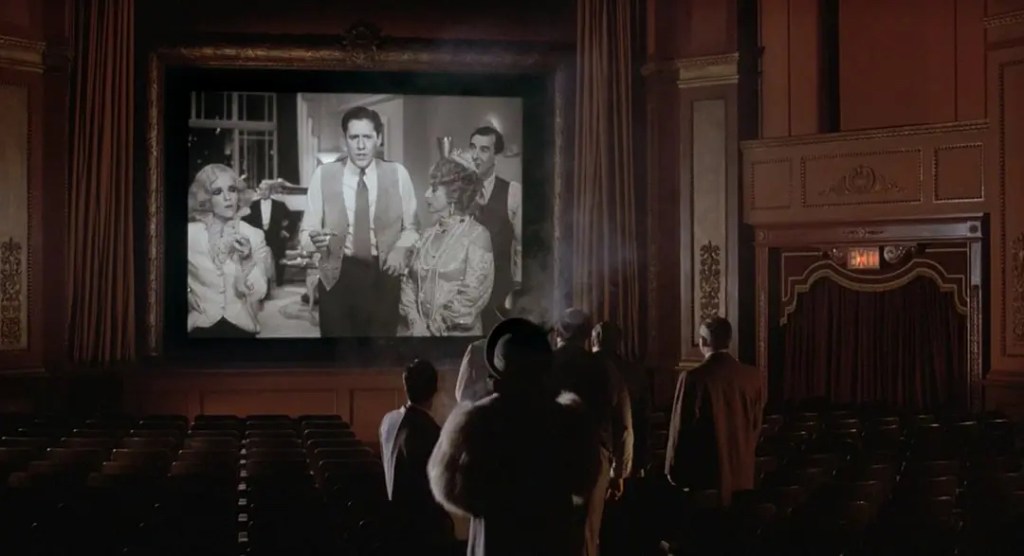
When Cecilia takes Tom to church, Tom doesn’t know what a church is or what God is. Cecilia explains that God is ‘the reason for everything, the world, the universe.’ Tom realizes: That means God is the screenwriter of The Purple Rose of Cairo! Just as Tom’s introductions are always the same, Tom’s behavior is always adventurous. After all, he’s a character written in a script, he doesn’t have any choice. However, when Tom steps into the real world and still has to follow the character traits assigned to him by the script, the characters who remain in the film begin to awaken to their sense of self. They band together to complain about their dull and repetitive upper-class lives and pursue the things they have always longed for but had never been able to do.
When Gil, as the actor who plays Tom, comes to Cecilia also as her admirer, Cecilia has to choose between the two. She chooses Gil, who exists in the same reality as she does.
If Tom is fictional and Gil is real, what does Cecilia aspire to be? Cecilia puts her spirit into fiction, but in the end she chooses reality. Her choice of reality is more like a daydream, a Hollywood star can’t drop everything to be with a girl from the bottom of the social ladder like the prince and Cinderella. In the end, when Cecilia returns to the cinema again, the time for the screening of The Purple Rose of Cairo has passed and a new film begins to play on the screen.

So, let’s exit beyond the two screens, while Cecilia is watching The Purple Rose of Cairo and we are watching THE PURPLE ROSE OF CAIRO, how does the fictional and real world of cinema look to us? Of course, we know that in the real world film characters don’t really come out of the screen (no Sadako!). When we sit in a darkened theater, which world do we return to at the end of the film?
Images adapted from: The Purple Rose of Cairo (a film by Woody Allen, 1985)
 The Polyphony