

Written and photo by Genki Hase
Edited by Wakaba Saito & Shan Min Kha
On July 1, we—some interdisciplinary students from Kyushu University Graduate School of Integrated Sciences for Global Society—visited Genkai Sea coastal areas in Saga Prefecture for fieldwork. It was a moment when/where different gazes on landscapes juxtaposed: One looked into rocks on the shore, another looked into aquatic insects, and I, a cultural anthropology student, looked at the people who looked at different things at the same time-space. This essay is a patchwork of such juxtaposition.
The Wind Farm
At Karatsu-Chinzai Wind Farm owned by Kyuden Mirai Energy, there are 8 windmills in operation. Each windmill stands at 133.5 meters, making it taller than the iconic Fukuoka Tower. The windmills are built tall, or specifically speaking, the blades are built long, to increase the wind reception area so that it can fully utilize the wind to generate electricity. In theory, longer blades are more effective; however, transporting them during construction poses significant challenges. “This is one of the reasons why an off-shore wind power plant is sought out as a solution,” says Sato from a leading company in renewable energy.
This wind farm could generate electricity for approximately 157,000 households annually, which is about one-third of Karatsu city’s population. Despite this potential, wind farms encounter various challenges in realizing their goals. One example is the construction. Constructing a windmill requires a paved road for transporting materials and an environmental impact assessment must be completed beforehand. “It takes two to four years for this assessment to be done,” says Sato. In this environmental evaluation process, the energy company must comply with the forestry law, electricity company law, and other laws and standards that qualify the company to build a power plant. In addition to the (pre-)construction, wind power faces another limit regarding the profitability of generated electricity. Since generated electricity will be sold to Kyushu Electric Power Company (Kyuden), the upper-capacity of generation depends on the specification of Kyuden’s electric grid. This implies that the generation capacity of windmills is not fully utilized when other power sources are active on the grid. Furthermore, wind farms—or more in general, renewables—find difficulty meeting the supply-demand evaluation which is a necessary process of buying and selling electricity. This is because while electricity demand rises or falls, the wind may not blow responding to that demand. To solve this, further improvements in storage technology are required. Renewable energies hit their limit with existing techno-political frameworks.
Vegetation around the windmills

Beside the wind farm, there were tobacco leaves planted on a field. “This is a common sight in Africa,” says a professor. Surrounding the field was the evergreen conifer, mostly Japanese Cedar (sugi), being planted. Native Japanese Cedar could be found in mountainous and snowy terrains, yet I am spotting them at a plain land just beside the field. Why? During the postwar reconstruction era (mid 20th century), building materials were scarce and were in desperate need, so people at that time planted Japanese Cedar—a tree that grows straight up and produces light and soft woods. Today, the majority of woods are imported and such “artificial forests” are thought to be the cause of increasing pollen allergy. Forest became field and field became forest. Ecological disturbances are altering the sight and ways of life.
Coastal landscape allowed us to speak
At noon, we arrived at Nanatsu-gama, a site well-known for spectacular views. Here in the coast, I observed a lot of hexagons composing the spectacularity of the terrestrial uniqueness. This coast is formed due to the erosion of basalt, a very hard rock that resists erosion. The flat plane of basalt just beneath the sea level was observable when I looked at the eroded coast.
Sitting on the basalt coast, my friends and I had lunch. Unlike most of the participants who bought their food in the supermarket or convenience store, we coincidently brought our own bento on site. We took a photo together with the bento and started eating, but as we ate, we began to discuss topics we usually do not share with others. I cannot elaborate on our discussion, but we shared about ourselves and the environment in which these selves are cultivated. It was similar to the practice of a Christian confession, or what Michel Foucault (1988) called “technologies of the self.” The sea breeze, black basalt, white-capped waves, seagulls, and different but similar selves. Away from the campus, the coastal landscape and its time-space specificity allowed us to speak of unspoken, private, but important things to ourselves.
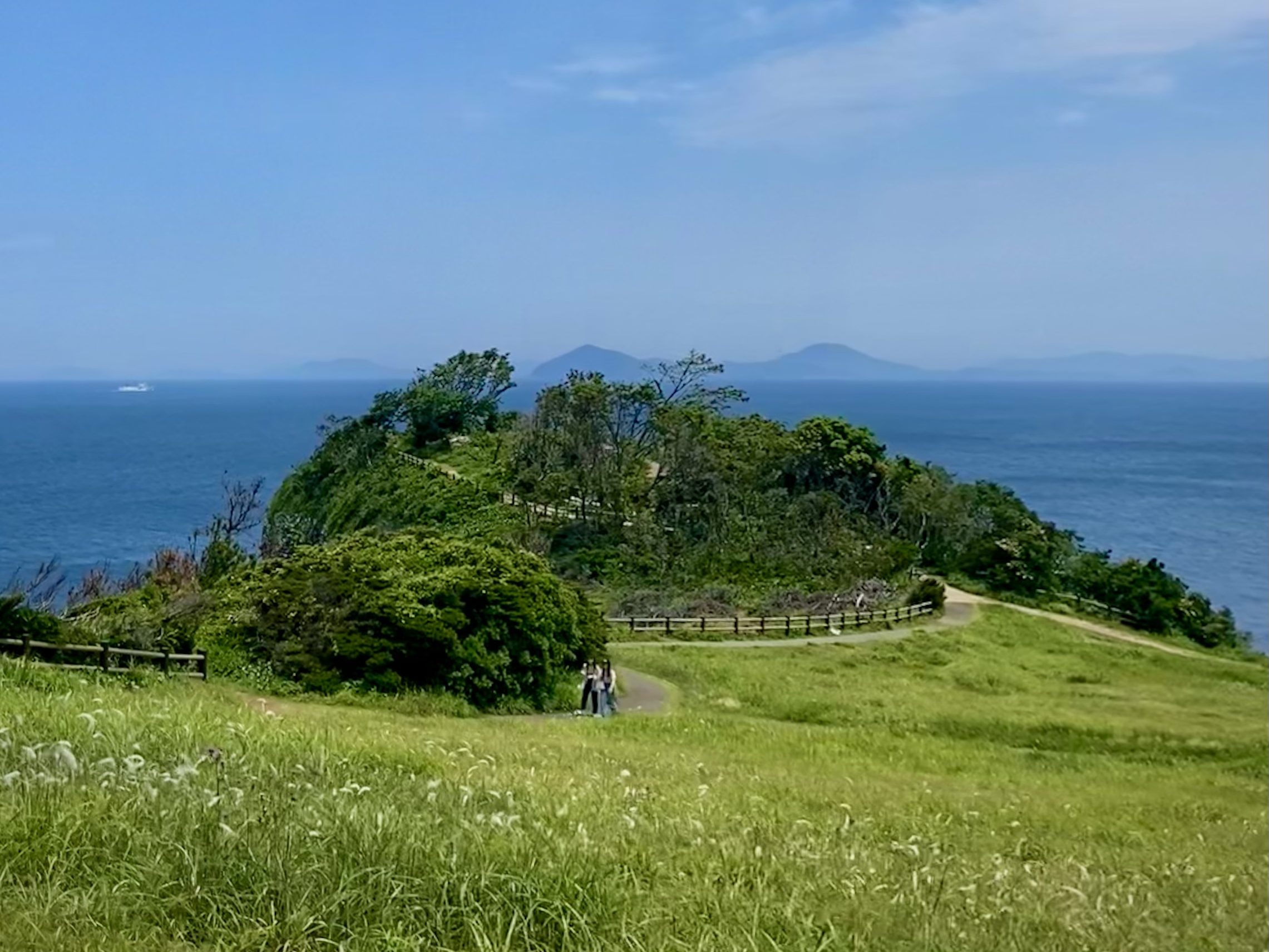
Hadomisaki Observation Tower
“Look! It looks like human eyes… They’re watching our souls.” This word was said by student A at Genkai Kaichu Tenboutou (Genkai Under the Sea Observation Tower in direct translation) gazing at a fish called Kurodai (black seabream). Kurodai is a 30cm fish that feeds on bivalves, crustaceans, polychaetes, and seaweeds. It is known to be an actor who induces rocky-shore denudation (isoyake) by eating weeds. Other factors related to rocky-shore denudation include an increased urchin population and change in water temperature, which are also interesting topics to explore; however, what intrigued me most during this fieldwork was A’s statement.
The observation tower is circular in shape. To get to the under-the-sea observation floor, the visitors must cross a bridge and take the stairs. On the floor, visitors can see different kinds of fish, seaweeds, shellfish, and terrain through windows. Occasional projection mappings illuminate the experience of being in the sea. The architecture of this place reminded me of Jeremy Bentham’s concept of the panopticon and Michel Foucault’s discussions of surveillance and gaze. Panopticon is a prison architecture that is circular in shape. It is like the shape of a donut imprisoning prisoners along the circumference and locating an observation deck at the center of the circle. In this form of prison, guards can see the prisoners but the prisoners cannot see the guards—leading to the internalization of watchful eyes (Foucault, 2020).
One remark could be made from this parallel in relation to A’s statement “They’re watching our souls.”: We know that we are being watched. An observation tower, by definition, is a place to observe something. A place to watch something. But in other words, it is a place where we become a being to watch others. If one being emerges inter-relationally with other beings (e.g. with family, words, sounds, odors, buildings, foods, and spirits), our selves are also part of others that form our life. When we gaze upon something, we are not only seeing it but also reflecting ourselves in it. Any place and occasion could be a place for self-reflection and self-cultivation. An experience at Hadomisaki was one instance that proved the classical sociological discussion of seeing yourself through others’ “looking-glass self” (Cooley, 1983).
After Returning Home
The fieldwork at the Genkai Sea Coast has ensembled different voices voiced in different landscapes. Gazing at the same landscape but in a different manner, we come to notice that the self is not singular nor eternal; rather, it is an existence that emerges and sparks in resonance to others. The others, here, do not exclude blades, rocks, cedars, rocks, and fish. The Wind allowed us to knit our language, and hence, our selves.
Reference
Cooley, C. H. (1983). Human Nature and the Social Order. Routledge.
Foucault, M. (1988). Technologies of the self. In Technologies of the Self (Martin, L., Gutman, H., & Hutton, P., Ed.), 16-49. University of Massachusetts Press.
Foucault, M. (2020). Surveiller et punir: Naissance de la prison [監獄の誕生:監視と処罰] (H. Tamura, Trans). Shincho-sha. (Original work published 1975)
 The Polyphony