
Written by Snow Myo Myat Hnin
Co-edited by The Polyphony Team
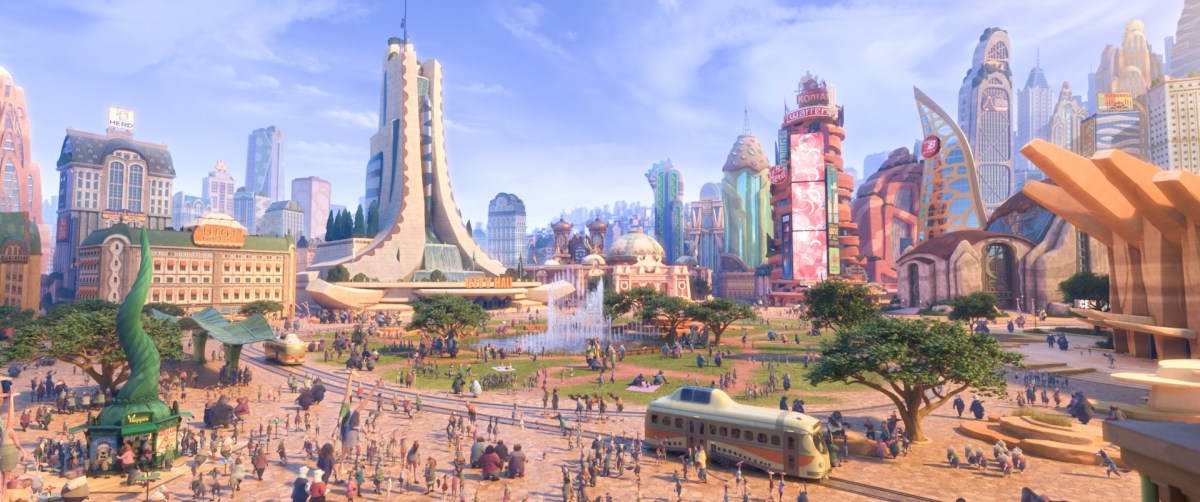
When I watched Zootopia as a 10-year-old, it appeared to be a cheerful, progressive story about inclusion, self-determination, and “cute animals”. Zootopia is a movie about an animated city, or metropolis, where predators and prey live side by side. The city’s inspiring motto, “Anyone can be anything,” enhances this image of diversity and modern urban life, where there are no limitations on who or what you can be. But is that really all Zootopia is showing us?
When viewed through a sociological lens, this surface optimism starts to crack. Beneath the colorful harmony is a carefully managed system of fear, control, and separation. In Zootopia, predators are not judged by their actions or even by what they have done in the past, instead, they are judged by the potential for violence that is presumed to be embedded in their biology. This fear is not simply a response to danger; it is built into the very infrastructure of the city.
In this paper, I explore how Zootopia fantasizes a city where control operates not only through visible structures and laws but also through spatial design, media narratives, selective historical storytelling, and the everyday rhythms of urban life. I argue that while the film appears to resolve the story’s tensions through optimism and personal growth, these resolutions are largely surface-level. By focusing on individual success, the film repackages legitimacy and makes the system seem fair, even as it leaves the deeper structures of inequality untouched. The analysis focuses on how fear becomes infrastructural, how “inclusion” becomes selective, and how legitimacy is created through appearance rather than justice.
Performing Diversity
The story of Zootopia begins with the main character, Judy Hopps, a young rabbit from a rural town called Bunnyburrow, whose dream is to become the city’s first bunny police officer. Coming from a town where almost all bunnies are carrot farmers, Judy’s ambition is dismissed and mocked at by everyone who hears it, including her family, who say, “We gave up on our dreams, and we settled” (Zootopia, 2016). This line, seemingly lighthearted, reflects the broader cultural message that success is not for everyone and that most people should simply accept their place in society. Judy’s determination to defy this expectation becomes the emotional backbone of the film. But at the same time, it quietly reinforces the idea that only a few exceptional individuals can actually succeed, while most are expected to settle.
Judy’s journey is accompanied by another main character, Nick Wilde, a predator who has been prejudged and isolated because of his species. After realizing he’ll never be trusted, Nick decides to play into the stereotype and becomes a hustler. Eventually, though, he ends up helping Judy and becomes her partner in law enforcement. Here, we see that both protagonists are defying expectations and, at the end, are rewarded with respect and recognition when they were awarded stars at the end of the movie for their heroism. After all, the movie has a happy ending. Or does it? Because this “happy ending” is really focused on the individual level, where Judy and Nick are framed as exceptional cases. Even the city’s motto, “Anyone can be anything,” turns into a kind of subtle control. It suggests that if Judy can do it, anyone should be able to, and if they can’t, maybe they just didn’t try hard enough.
As Hassler-Forrest (2019) argues, “Zootopia’s representational gender politics play directly into the neoliberal agenda, illustrating once again that success in the workplace is an entirely individual matter: it is up to Judy alone to find the wherewithal to succeed in an unfair world rather than to question or challenge the coordinates of that world’s political organization” (pp. 364–365). In other words, Judy’s or Nick’s personal success story doesn’t expose the system’s flaws; it masks them. And by highlighting their exceptional paths, the film shifts our attention away from the deeper social structures that decide who belongs where, who is feared, and who gets to be seen as legitimate.
Rhythm, Space, and Security in Zootopia
In Zootopia, security isn’t just something that appears during emergencies; it’s already built into the city’s infrastructure. From the moment Judy is riding on the high-speed train, we see a city divided into distinct ecological districts such as Tundratown, Sahara Square, and the Rainforest District, each divided and closed off by borders and sustained by artificial climate systems. These zones appear to accommodate diversity, but they also enforce spatial separation. As López Fuentes (2021) writes, “In Zootopia, the city is presented as a borderland where the action unfolds in several important spaces. It is a geography of power that produces an unequal geographic democracy (Massey 119).” (p. 175). In other words, what looks like a harmonious coexistence of all the species is in fact “a performance of segregation.”
We can also see security acting as an infrastructure that governs subtly. Carriere and Tripathy (2024) help us understand this: “… we argue that infrastructuring as a function entails the making of socio-material arrangements into infrastructures that become deeply integrated into the fabric of collective life and have the potential to transform and restructure territoriality, sociality, perceptions, and experiences of urban life.” (p. 135). Zootopia’s spatial layout doesn’t just organize habitats; it governs access, movement, and even perception. The walls between Sahara Square and Tundratown, the sprinkler-fed rainforest, aren’t just physical features; they are instruments of control that determine who can go where, when, and under what assumptions.
These infrastructures also produce rhythms. Drawing on Lefebvre’s rhythmanalysis, we can think of the city as performing eurythmia, a state where time, space, and social life are in a smooth, seemingly natural flow. At first, predators and prey coexist in shared spaces like downtown, and daily life appears calm and synchronized. But once the first “savage” predator attacks, that rhythm is thrown off. The city breaks into arrhythmia, portrayed by emergency broadcasts, mistrust, and sudden harsh separations. Public news announces danger alerts. Children are pulled away from predator adults on trains. What was once ordinary circulation is now broken.
Narrative Infrastructure and Mediatization of Fear
Zootopia’s control isn’t only built into walls, rhythms, or spatial divisions. It’s also built into the stories the city tells and doesn’t tell at the same time. From the very beginning scene of the movie, we are introduced to this narrative framing in the school play, where Judy cheerfully narrates predator-prey history: “Thousands of years ago, these were the forces that ruled our world. A world where prey were scared of predators. And predators had an uncontrollable, biological urge to maim and maul… But over time, we evolved and looked beyond our primitive savage ways” (Zootopia, 2016). It’s a neat and optimistic version of the history, which is also completely one-sided. There’s no mention of oppression, resistance, or historical conflict, just a vague sense of “evolution towards coexistence.”
Judy’s personal struggle as “small prey” is shown as the main plot in the film. We get her backstory in detail, from her childhood dream of becoming a cop to her struggles at the police academy to the emotional highs and lows of solving her first big case. But in contrast, predator communities don’t receive the same narrative space. We don’t hear from a single predator elder, teacher, or community member reflecting on how the city’s systems affect them. There’s no predator equivalent to stories of discrimination or public history of predators at all. Trouillot (1995) reminds us that “the widespread notion of history as a reminiscence of important past experiences is misleading” (p. 14). What gets remembered and what gets left out shapes how people understand the present. The result isn’t necessarily intentional erasure, but it does create a kind of narrative imbalance. Without stories, predators appear to have no history. Without history, it’s easier to believe that the current social order, which is marginalization in this case, is natural. It’s a reminder that narrative, just like space or security, can become a subtle form of infrastructure.
This narrative gap becomes bigger once predators start going “savage.” Zootopia’s media doesn’t investigate. Instead, it amplifies the fear by having the news play surveillance footage of the predators going savage, and dramatic headlines flash across public screens, turning isolated events into a city-wide panic. Törnberg and Uitermark (2023) explain that the “mediatization of a place means that media representations of that place multiply and become more tightly interwoven with its everyday life, changing both the stakes of local politics and the range of actors involved” (p. 343). In short, the media in cities doesn’t just reflect reality; it helps narrate it. In Zootopia, the media is shaping how the public sees predators, not as individuals, but as a threat category. The media doesn’t just report fear; it builds it into the city’s infrastructure.
In the movie, Zootopia presents itself as a city of possibility. Its famous motto, “Anyone can be anything,” sounds hopeful. It pictures a place where personal effort matters more than background, where your identity doesn’t determine or limit what you can become. But this message also does more than it seems. It gives the impression of equality while overlooking how some groups, especially predators, are still treated with hidden distrust, not because of what they do, but because of what they might do due to their biology. The city looks inclusive on the surface, but that inclusion has limits, and those limits are built into the infrastructure of the city.
This is what Banerjee (2024) describes as ideological legitimacy when systems use appealing messages to justify policies that maintain existing systems. Like the “cultural preservation” narrative in the Enninglu redevelopment, Zootopia’s message of diversity hides the ways exclusion still works. Predators are sidelined not just by fear, but by a lack of voice. Their stories are missing, and without them, it becomes easier to accept the current situation.
Throughout the film, we’ve seen how control operates not just through obvious rules, but through everyday systems such as spatial design, time regulation, selective storytelling, and media. These elements don’t just reflect the city; they are built into it. Security is built into the habitats. Silence is built into the narrative. Fear is mediatized through screens. All of these work together to maintain a sense of order that feels natural but leaves key problems unaddressed.
Zootopia ends on a positive note, with Judy and Nick working together as equals. Their individual success seems to prove that progress is possible. But this ending focuses on personal achievement rather than structural change. The deeper systems that divide and manage the city remain in place. Rather than offering a clear answer, the film leaves us with a question: What kind of coexistence does Zootopia actually show? Is it one built on real inclusion, or one that manages difference just enough to make it seem fair?
Bibliography
Banerjee, S. (2024). Cultural Policy Formation and State-Society Relations: Culture-led Urban Redevelopment of Enninglu in Guangzhou. Manuscript in press.
Carriere, D., & Tripathy, P. (2024). Security as infrastructure: Controlling the rhythms and spacetimes of the city. In O. Coutard & D. Florentin (Eds.), Handbook of Infrastructures and Cities (pp. 134–146). Edward Elgar Publishing.
Hassler-Forrest, D. (2019). Neoliberalism in Zootopia and Orange Is the New Black. In M. Yuen Chi Chow & A. E. Mathijs (Eds.), The Netflix Effect: Technology and Entertainment in the 21st Century (pp. 357–370). Bloomsbury Academic.
López Fuentes, C. (2021). Cosmopolitan border urbanism: A reading of Zootopia. In S. Haas & L. L. Martín (Eds.), Border Urbanism: Transdisciplinary Perspectives (pp. 171–187). Springer.
Trouillot, M.-R. (1995). Silencing the past: Power and the production of history. Beacon Press.
Törnberg, P., & Uitermark, J. (2023). Urban mediatization and planetary gentrification: The rise and fall of a favela across media platforms. Cultural Geography, 30(3), 339–355.Walt Disney Animation Studios. (2016). Zootopia [Film]. Directed by B. Howard & R. Moore. Walt Disney Pictures.

