

Written by Snow Myo Myat Hnin
Co-edited by The Polyphony Team
I don’t wake up alone anymore.
Even before I open my eyes, something, or maybe “some things,” are already waiting. The alarm has gone off, not once, but in a carefully planned sequence I set the night before, because one part of me was hopeful about the idea that I’ll wake up early and go for a run, while another part of me knew better.
My hand finds my phone before my eyes are fully open. The screen lights up with the day’s schedule laid out by Google Calendar, messages I didn’t respond to, and a strange sense that something is already expected of me: to be on time, to be caught up, to be okay. There’s also a soft pressure to appear rested. But what does that really mean? It’s not just about having slept. Rested means looking like I’ve processed everything, like I’ve reset overnight and am ready to re-engage, with a clear head and stable emotions. It means appearing like I’m in control of my time, my energy, and my mood. In this way, rest becomes less about recovery and more about regulation. It’s not only about how I feel anymore. It’s about whether I can present myself as functional in the system I’m a part of. Maybe that’s what Deleuze was getting at when he described the shift from discipline to control societies: a world where rules and regulation doesn’t come through rigid structures but through modulations: nudges, reminders, numbers, and moods (Deleuze, 1992).
I used to think waking up meant beginning again, like opening a blank page into a fresh new day. Now it feels more like syncing back into something already running. Maybe an assemblage of apps, responsibilities, routines, algorithms, and quiet demands that form who I am and how I show up every day.
Naturally, the first thing I do each morning is turn off Do Not Disturb and scroll through social media. I’m not really absorbing anything, but I’m still trying to connect myself to the day. It’s not exactly a conscious choice, but a way of easing into wakefulness through familiar gestures. Instead of saying “I’m ready,” the day starts with negotiations between habit and muscle memory; the brain that partially recalls what it was worried about the night before, the thumb that knows where the app is without looking, and the routine that doesn’t require conscious thinking to follow.
This is more than just about “me using tools.” It’s more like being created by them, through them. And I know now: it’s never just me in the room. The calendar shapes my time; the algorithm behind my feed subtly molds my mood, the interface nudges how I respond to whatever pops up on my screen. What Yan (2024) would say, building on Haraway’s idea of “becoming-with,” is that this isn’t just me waking up; it’s me “becoming-with the systems around me. Drawing on Harris’s words, he puts it this way: “that myself as I understand it at this place, and time, and awareness, is a co-production with them” (as cited in Yan, 2024, p. 258). I don’t simply wake up as myself; I wake up as a part of a web of cues and demands that initially shaped who I am. My sense of self doesn’t come from one center. It’s scattered, shared, and made together with the tools I rely on.
That’s why Deleuze and Guattari (1987, as cited in Yan, 2024) describe people as machinic assemblages, saying that we are not just individuals but a mix of parts that work together: body, habits, feelings, technology, and environment. I’m not just one solid “self.” I’m more like a system that keeps adjusting, part phone, part schedule, part emotion, and part muscle memory. And maybe that’s not a problem. Maybe that’s just what it means to be a person now.
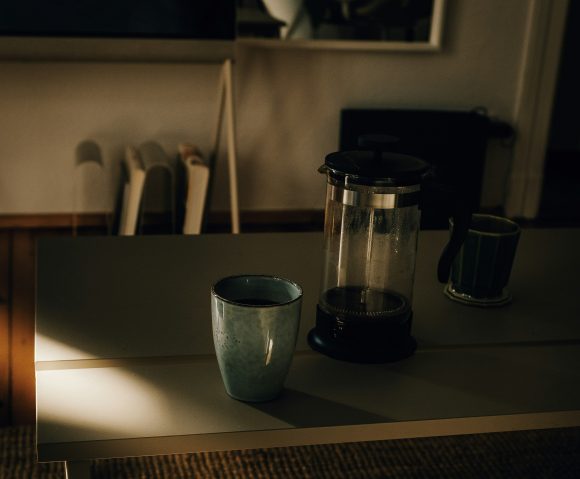
Haraway might nudge me to take this even further. Earlier, I thought about her “becoming-with” mostly through Yan, focused on technology. But Haraway reminds me it’s not only just about humans or machines. She says becoming-with means who we are takes shape through entanglements with all kinds of nonhuman others (Haraway, 2008). And honestly, I see that too in my mornings. My coffee isn’t just a drink; it’s a small part in a wide net of relations. Beans grown across the globe, factories producing coffee powder, and heat, taste, and caffeine shaping how I feel. Even the Wi-Fi signal, the vibration of my phone, and the applications on my screen are not just passive objects. They co-compose my morning. Haraway would say subjectivity is not a solo act; it’s something made in the middle of these entanglements. Gilbert, the developmental biologist she draws from, puts it even more bluntly: “We were ‘never’ individuals” (Haraway, 2008, p. 33). From the cellular level to how I drag myself into the day, it’s always a matter of co-constitution of living and becoming through interaction. If there’s a self at all in the morning, maybe it’s not mine alone.
These interactions with systems don’t just shape me, though. They also invite me to respond or resist with small actions. Here, it is not resistance in the big, dramatic sense, but in how I manage to stay present. I scroll through my phone, make coffee, and clean the room. These small acts help ease me into the day. They create a bit of structure, enough to get going. If Biehl were watching, I think he’d say this is what subjectivity often looks like, borrowing from Deleuze, a “map of trajectories and intensities” (Biehl, 2010, p. 68). It’s shaped through everyday entanglements of desire, symptoms, and technologies. Biehl was writing about psychopharmaceuticals, but I think the idea can be used beyond that. Maybe these routines aren’t about expressing who I am but simply about keeping things going. Not to take control of the day, but the desire to find enough steadiness to stay with it. They help me piece together something manageable, a way to move through the morning without feeling lost in it.
I used to believe in a stable, coherent self; something I could return to after stress, burnout, or a bad week. I thought that maybe there was some “core me” waiting to reappear once I got enough rest, caught up on deadlines, or remembered how to care. But now, I’m not so sure it was there to begin with. My sense of self feels more like something that I improvise daily, a pattern that holds just enough for me to stay recognizable to myself. Biehl, again, would probably nod at that. In Vita, he doesn’t define subjectivity in closed terms, but he shows it through Catarina’s notebooks, her shifting states, and her efforts to make sense of herself in the margins of care (Biehl, 2010). Subjectivity, for him, seems less like a stable identity and more like a fragile, relational process that is always adjusting, always responding. It’s not something purely internal or external, but something that takes shape through writing, waiting, remembering, and surviving. I think I’m starting to get what he means. It’s not about uncovering some deep, hidden truth about who I am. It’s about noticing how I become, day by day.
Maybe the question isn’t “Who am I really?” but “What am I ‘becoming-with’ today?” That small shift takes the pressure off finding some deep, hidden truth and turns the focus toward noticing what I’m entangled with, what I’m responding to, and what I’m co-creating. There is no single center holding it all. There is no core that stays untouched when everything else shifts. But maybe that’s not such a bad thing. Maybe that’s a kind of freedom. Haraway would likely say this is the point: that we were never autonomous to begin with (Haraway, 2008). Coffee, light, language, bacteria, notifications, and care, maybe they’re all part of it. Subjectivity, in this view, is less about being rooted in the center and more about being in relation.
So when I say I don’t wake up alone, I mean it literally. I never did.
There is no returning to some original “me,” because that “me” was never singular. It was already mixed up and distributed across systems, screens, habits, and routines. “Becoming a self,” I think now, isn’t about reclaiming independence or shutting things out. It’s about learning to stay a part of this messily beautiful assemblage.
To stay in the middle of it all and keep going. Not to reach a final point, but to continue.
Bibliography
Biehl, J. (2010). “CATKINE…Asylum, Laboratory, Pharmacy, Pharmacist, I and the Cure”: Pharmaceutical subjectivity in the Global South. In J. Jenkins (Ed.), Pharmaceutical self: The global shaping of experience in an age of psychopharmacology (pp. 267–295). School for Advanced Research Press.
Deleuze, G. (1992). Postscript on the societies of control. October, 59, 3–7.
Haraway, D. J. (2008). When species meet. University of Minnesota Press.
Yan, D. (2025). Posthuman creativity: Unveiling cyborg subjectivity through ChatGPT. Qualitative Inquiry, 31(2), 253–264.

