
By Kha Nguyen
“Mekong Delta is the largest rice-producing region in Vietnam, accounting for over 50% of the domestic rice production and 90% of rice exports. In 1990, the GDP of Mekong Delta was 1.6 times bigger than the country’s largest economic hub Saigon, and accounted for more than 25% of the country’s GDP. Two decades later, the rate was completely reversed: the GDP of Mekong Delta is now only 2/3 of Saigon, and the region has been falling behind further and further.”
Annual Economic Report Mekong Delta 2020, VCCI & Fulbright
1986 was a year when Vietnam started to open its economy to the world. The recovery of the private sector followed by massive amounts of foreign capital inflow, has propped up the economy, fueling rapid economic growth in the 90s and early 2000s. During the transitional years, poverty reduction appeared to be among the biggest achievements for this fast-growing economy. According to the UN report, the poverty rate in Vietnam dropped from 58% to 12% (1993-2011), with around 28 million people estimated to have escaped from poverty over two decades.
In the early years of Đổi Mới, agriculture in the Mekong Delta was one of the key drivers in lifting Vietnam out of poverty and facilitating the country’s economic growth with stable foreign capital through annual exports. Today, the region is not only feeding a 100-million-people country as the primary food source, but also contributes approximately 80% of the country’s total agricultural export turnover each year. But yet, the most fertile land in the country is failing to bring prosperity to its people.
Rice – the dilemma of “food security”
The roots of the “debt” in the Mekong Delta trace back more than two decades. After the fall of Saigon in 1975, the new communist government in Hanoi faced a dire challenge: a nation on the brink of food shortages. The collectivization policies have failed to motivate farmers to increase their production volumes, leading to a stagnation of rice production and an annual dependence on grain imports of 1–2 million tons by the 1980s.
Eventually, the abolishment of collective farms, liberalization of agricultural sectors, and progress in land reforms gradually revitalized Vietnam’s rice production in the 1990s. Central to this recovery was the transformation of the Mekong delta emerging as the nation’s “rice bowl”, with government investment in irrigation projects playing a key role in supporting agricultural intensification. Flood control dikes together with salinity-prevent dams were built to keep floodwaters and saltwater away from farmland, and this “freshened zone” has allowed farmers to boost rice production with more than two rice crops per year instead of one, turning Vietnam from a food-deficient country into a top rice exporter.
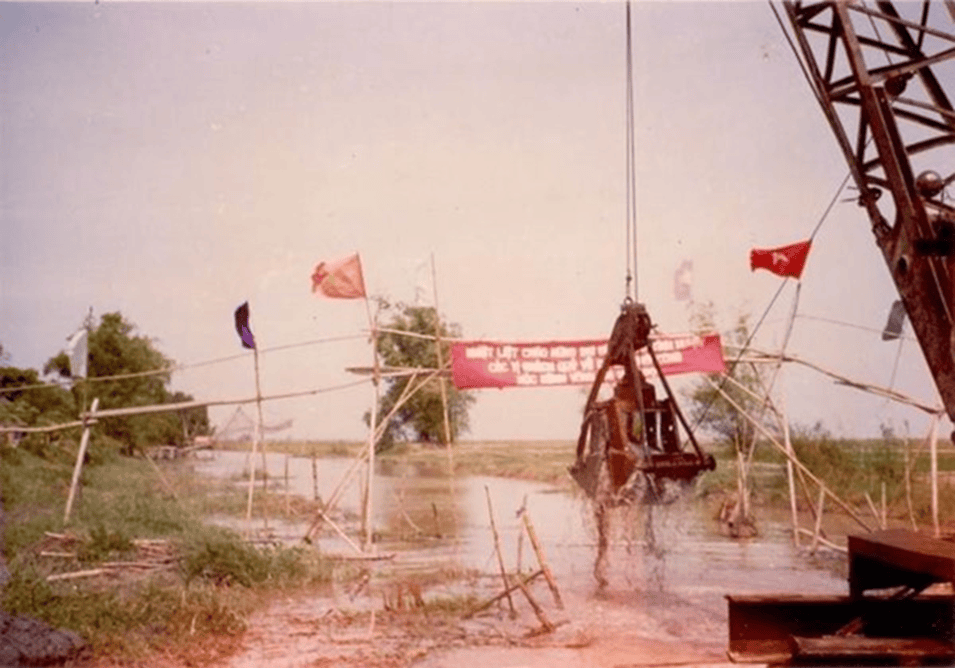
Photo: The memoirs of Minh Nhi.
However, many farmers fell before they could even “fly”: the cost of water control policies was the loss of nutrient-rich sediment that the floods used to bring to the fields.
For centuries, farmers in the Mekong delta followed the sustainable cycle of growing a single rice crop per year while allowing the soil to recover during flood season with the sediments from the river. When the dikes stopped the water from flowing into farms, the soil become less fertile with no sediment supplements. Intensive agriculture has continuously strained the recovery ability of the soil nutrients and led to significant soil degradation, forcing farmers to increasingly depend on chemical fertilizers to sustain crop yields. From around 180 kg/ha in the 1990s, the use of NPK1 fertilizers alone in Vietnam exceeded 400 kg/ha in 2019, with total fertilizer application reaching up to 550 kg/ha. This is twice the amount of NPK fertilizers used in Thailand, a major rice-exporting country in the neighborhood of the Mekong Delta region.
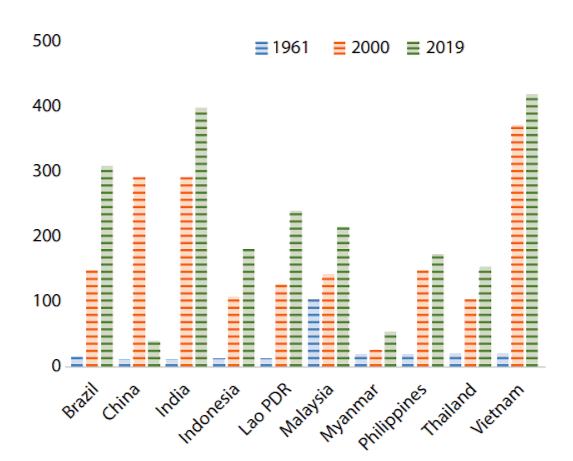
Source: World Bank, FAOSTAT 2020
In the absence of floodwaters that once naturally cleansed the pathogen’s soil, pests become another threat for farmers, as they can remain in the soil for many years and microbial groups like fungi and pathogenic bacteria are particularly attracted to plants that absorb high levels of nitrogen fertilization.
Rice farming isn’t a profitable business with a very slim margin, which means that any risks could turn into huge losses. That’s why, to protect the crops from diseases, farmers spray pesticides an average of 8 to 10 times per crop, targeting everything from snails, mites, mosquitoes, planthoppers to weeds, fungi and grain sterility.
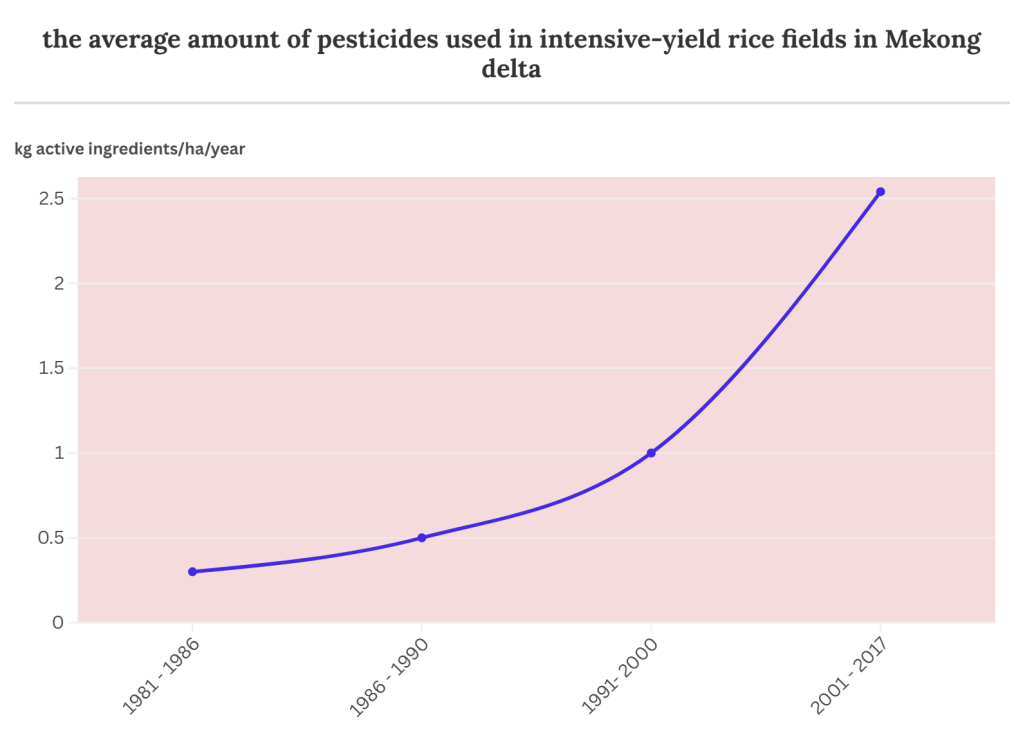
A report by the International Pollutants Elimination Network (IPEN) reveals that pesticide usage in the Mekong delta in 2017 has increased more than five times since 1981. Particularly, average use of pesticides in An Giang, the second-largest rice-producing province in Vietnam, is almost three times higher than the global average, with many of them consisting of cheap toxic pesticides that belong to hazardous categories under the WHO classification (Pham et al., 2012). This excessive reliance on chemicals has not only increased the risk of pesticide auto-immune resistance in pests, but also damaged the ecosystem and beneficial insects that contribute to organic decomposition and soil structure, which eventually needs fertilizers even more for nutrient replenishment.
The cycle of dependency on pesticides and fertilizers continues to escalate, as global research has shown that less than 0.1% of applied pesticides effectively reach the target pests, with the remainder contaminating the soil, water, and air (P. David, 1995). Human exposure to these chemical pesticides is associated with chronic health issues such as cancer, heart disease, respiratory problems, neurological disorders; and farmers are the first to suffer from the pollution they have unintentionally created to sustain their livelihood.
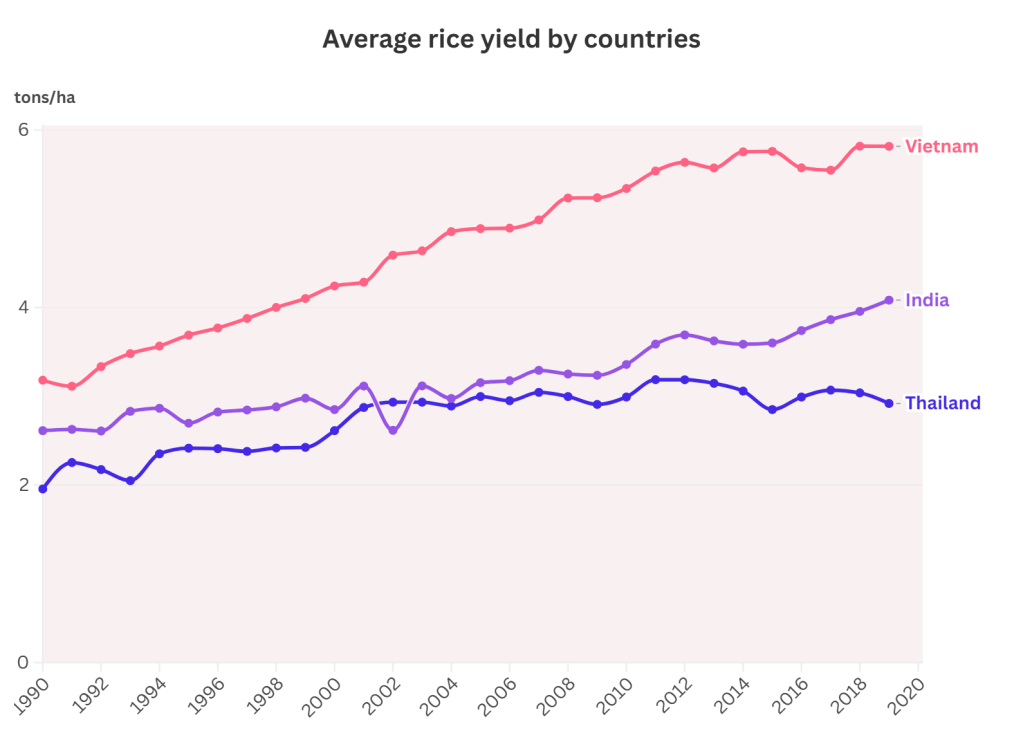
On the surface, the prospects seem to be bright for the delta when it can consistently maintain rice yields hovering around 5-6 tons per hectare, with some areas even producing over 7 tons per hectare—more than one-third that of India and Thailand, the world’s first and second-largest rice exporters. But to achieve such high productivity, farmers have to use a large amount of fertilizer and pesticides in their fields, so much that the cost of these inputs accounts for nearly half of the total expenses for rice cultivation. (GSO, 2021)
“No matter how expensive the pesticides are, we still have to buy them”, said Luong, a veteran farmer in An Giang province. For farmers, the pressure is not only coming from the fear of crop failure, but also from the supply and demand side, Luong explained. “From fertilizer, pesticide dealers to seed sellers, they all find ways to squeeze us in prices; and rice traders can reduce the price if the rice doesn’t look shiny”. One mistake can easily wipe out 5-10% of the selling price per kg, or cost them the entire harvest, in some cases. Indeed, Oxfam research found that Vietnamese farmers receive the smallest share of the value chain, taking only 4–17% of the consumer price compared to around 25% for retailers and distributors.
Even in a good season with favorable market prices, Luong said he only earns around 15-20 million VND ($610 ~ 815) per hectare for a 100-day crop cycle, after covering the input costs. Luong and his wife have been working hard on a farm for 40 years in return for a very low income: 150,000 – 200,000 VND ($6~8) per person per day. This is the decent amount the ordinary farmers can get from rice farming in good times, but on average, their income is just above the national poverty threshold of around $3.20 a day. For those who have to rent land for farming, their monthly income might be below the poverty line.
The once-promising model of intensive rice farming has shifted from being a win-win opportunity for smallholder farmers to a precarious livelihood of people in the delta. In fact, it was the outcome of top-down government directives rather than a collaborative consultation with local communities. As Prof. Thong Tran, an expert in environmental governance in Southeast Asia from Australian National University argued, the government has adopted an over-simplistic agricultural water management approach that overlooked the sustainable livelihoods of local farmers and failed to adequately address the potential environmental harm, all under the banner of national food security, export opportunity and climate change adaptation.
Despite being part of the multi-billion-dollar rice chain of one of the world’s rice powerhouses, the Mekong delta has remained a small-holder economy with 70% of households owning less than 0.5 hectares of land. Intensive agriculture has grown into a massive economic pie from which only a select few like large-scale operations and state-owned export corporations can truly benefit, leaving smaller family farmers trampled in its path without economies of scale. What is left for these hard-working farmers in a delta with some of the highest rice yields globally, is just bare minimum returns that help them compensate for their labor, while the repetitive cycle of fertilizers-pesticides has further eroded their earnings.
Shrimp – authoritarian policies
Since the 2000s, small-scale farmers in the Mekong Delta have been locked into a cycle of cultivating low-value rice crops by the irrigation system with exhausted soil and manpower. When rice no longer seemed viable, many farmers decided to invest all their savings into another livelihood that has higher profits to change their lives: shrimp farming. Yet, marine shrimp need saltwater, while most rice farmers are locked in the “freshened zone” created by dams and irrigation.
To raise shrimp, farmers have to dig ponds and extract underground saltwater through wells. The process of converting land required huge investments, but it didn’t stop the local people. Through interviews conducted by Prof. Gorman, an environmental sociologist at Montclair State University, it was revealed that farmers had to rent earthmovers to dig out ponds that cost between 20-30 million VND (~$1000), and the initial investment could reach up to 50-60 million VND (~$2500) when accounting the costs for shrimp stocks and other inputs. Furthermore, converting agricultural land to shrimp farming was technically illegal, as it violated the official land-use plan of the government.
In 2008, global rice prices suddenly jumped to record highs, driven by higher oil prices pushing up production costs, export ban in major rice-exporting countries and global panic buying. In March 2008, Vietnam imposed restrictions on rice exports to secure domestic supplies, and the government enacted stricter land-use regulations through Resolution 63 to curb the unauthorized conversion of agricultural land into shrimp farms for national food security.
Under these laws, farmers raising shrimp outside designated areas would be fined from VND 20-30 million and forced to dismantle aquaculture infrastructure unless it has been approved by the authority. In the summer of 2014, provincial officials were dispatched to key communes across the delta, where they destroyed illegal wells, cut through PVC pipes with machetes, confiscated diesel pumps, and sealed wells with concrete.
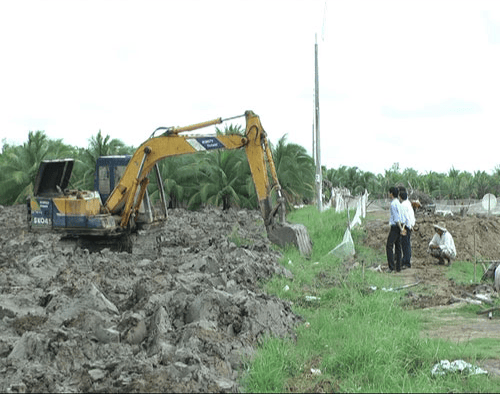
Photo: Son Tung
Prof. Brunn, a sociologist at Roskilde University, has identified this preemptive state intervention as a form of authoritarian environmentalism, where the government’s crackdown on national food security has stifled the independent changes of better livelihood within the local community, and ultimately it might lead to deeper poverty entrenchment in the low-value crops such as rice cultivation. The exclusion of shrimp farmers in the rural development policies was the legacy of the so-called “infrastructural power”, and the voices of poor communities are getting more and more marginalized with policies favoring large-scale agricultural interests.
As their dreams crumbled, shrimp farmers saw no other alternative but to continue their illegal shrimp farming, clinging to their last life jacket that shrimp could still provide a way out of their hardship. Many viewed it as a way to escape the cycle of poverty, but not a few of them fell even more deeply into debt. For those who had remained in rice farming, their lives weren’t getting any better. Recent devastating droughts and freshwater shortages in the Mekong delta have led to declining crop yields, oftentimes wiping out their all-year harvests. When both rice and shrimp failed, people started to sell their land, flee the countryside, and find work in the cities or nearby industrial zones.
For most of them, the destination is Saigon.
Moving to the city
Climate change, drought, poor harvest, low income, along with government law enforcement has been eroding the livelihoods of farmers in the Mekong delta. While some continue to persist and stay with their land, many are being forced to move to the city in search of work. Since 2009, the delta has been the only place in the country where the population has declined, with nearly 1.1 million – equivalent to the population of an entire province – migrating out of the region in the past decade.
The ongoing migration from the Mekong delta not only reflects the growing vulnerability of farming livelihood and the worsening impact of climate change but also exposes major shortcomings in the national social security system. According to Vietnam’s Ministry of Labor, Invalids and Social Affairs, only 35% of the population above the retirement age were eligible for monthly social insurance by the end of 2020, and these pension benefits depend on the individual’s contribution to the national insurance system in the former sector. However, many farmers in the Mekong Delta, who have spent their entire lives working on farms, are excluded from this system.
In 2008, voluntary social insurance was introduced to fill in this gap that could provide coverage for low-income farmers and informal workers. Under this scheme, individuals would have to contribute 22% of their monthly salaries for at least 20 years to receive pension payments upon retirement. However, for the migrant workers, their monthly wages are around VND 5 million (~$220), and spending nearly a quarter of their monthly income on insurance is an unimaginable burden for them. How can people think about 20 years ahead, when they have to worry about how to put food on the table for themselves and their families tomorrow.
Additionally, Dr. Nguyễn Đức Lộc, Director of Social Life Institute, pointed out another systematic loophole in Vietnam’s welfare system. Due to the population management policy based on household registration, it has “prevented older migrants from accessing social welfare”, Lộc observed. “They cannot receive poverty allowances or elderly subsidies in the city and must go back to their hometowns to get them”.
These structural and bureaucratic barriers have left many old migrants from the delta financially stranded, forcing them to navigate a system that has little protection for displaced rural workers. Nhung Nguyen, a freelance writer focusing on climate issues, has documented the struggles of Mekong delta migrants through interviews with former farmers who have relocated to the city. Among them is Tu Day and her husband, a middle-aged couple from Dong Thap moving to Saigon in 2016 after their livelihood was swept away.
Back in Dong Thap, her family owned a fish farm, but river pollution had caused mass fish death in their district in 2016. Drowning in debt, her family sold their land and migrated to the city. Now, at the age of 58, Tu spends her day cutting grass and sweeping leaves in a park, while her husband works in construction. Since moving, Tu says her health has worsened with more hospital bills, while her husband complains about feeling “suffocated” in the narrow room they rent in a city’s slum.
Lacking social insurance, labour protection, poor accommodation and low-quality diets, “older migrants working in manual jobs often find themselves trapped in a vicious circle of poverty”, says Prof. Giang at Hanoi National Economics University. Recent studies by public health researchers suggest that migration from the Mekong Delta to Saigon barely alleviated their socio-economic and environmental vulnerabilities; rather it is simply “a shift from climate risk to health danger”.
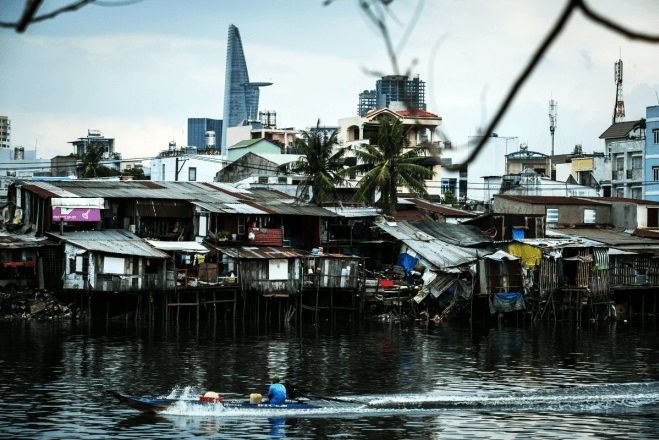
Photo by Thanh Nguyen (Vnexpress)
Saigon has been the country’s strongest migration magnet, but its rapid urbanization has outpaced the infrastructure development with many of the city’s newer districts being built on swampy land and rice paddies until the early 1990s. This uncontrolled expansion, in turn, has made Saigon one of the fastest-sinking coastal cities worldwide, alongside Shanghai in China and Jakarta in Indonesia. These newly developed areas located on the city’s outskirts are mostly home to migrants lower-income households, and ironically, those places are the most affected by the highest subsidence rate and frequent flooding.
Originally from Sóc Trăng, Diep’s family lives in District 12 to the north of the city, where she sells lottery tickets for a living. In April 2023, during the first heavy rain of the rainy season, Diep and her children’s tiny rented room was flooded with knee-deep water. “It came in from the street and rose up through the bathroom drain”, she remembered. “The water was dark as coal and smelled so terrible that I almost passed out”. The water lasted for two hours, and her family had to clean until midnight. “My skin got a bit itchy, but luckily we didn’t have anything too valuable to damage,” she laughed, half-joking.

Photo: Hong Lam
Diep is just one of thousands of migrants suffering from urban flooding in Saigon. In the Southern part of the city, District 8 – one of Saigon’s poorest districts – is flooded twice a month between September and February by the canal flowing through it. A few houses managed to raise foundations to prevent water and garbage from flowing inside, but for those who are poor migrant workers, they have been living with the flooding for years.
Moving to the city doesn’t guarantee anything, but for the young from rural areas, it’s still seen as the shortest way to support their family. Coming from Đồng Tháp, Hieu shares his story with AP news about his new life in Saigon: a 23-year-old young man now works two jobs — a 12-hour shift at a pharmaceutical factory followed by extra hours working as a motorcycle taxi. He once dreamed of becoming a literature teacher, but the drop in his family’s income in recent years made him decide to move to the city to help his sister finish school.
Nevertheless, he hopes to someday go to college and fulfill his dream of becoming a teacher.
“Everyone wants to return to the place they were born and raised,” he yearned.
Back to the delta: the trap in the Mekong river
For those who stayed behind, the delta no longer offers the security it once did after decades of intensive agriculture exhausting the soil’s natural fertility. But beyond the cost of controlling nature, farmers in the Mekong delta are also getting poorer by the dense network of hydropower dams on the other side of the border that has cut off the very foundation of prosperity in the delta.
The Mekong is no longer a natural river, as over 300 hydropower dams have already been built on it. These dams not only reduce water flow, but also block the sediment and silt from flowing downstream. According to the Mekong River Commission, since 1994, the annual sediment flow to the lower Mekong (Pakse, Laos) has sharply dropped from 147 million tons to just 66 million tons by 2013. When the river has sediment deficits to fortify the coastal soil structure, it is sand mining downstream that triggers devastating land erosion and threatens the lives of people along the banks.
The Mekong River has not only fueled the agricultural boom of the delta with its rich sediments but also provided raw materials for the infrastructure of rapidly expanding cities, factories and roads in Vietnam. A 2011 survey by the World Wildlife Fund (WWF) revealed that, during its peak of sand mining activities, nearly 50 million tons of sand and materials were being extracted from the river’s main channel every year.
As more and more dredging vessels take sand and sediment deposits from the bottom and the bank of rivers, the riverbed’s shape has been distorted, and the Mekong has become a “hollow river”. An independent ecologist Nguyễn Hữu Thiện from Cần Thơ explains, “A deeper riverbed means higher riverbanks. With the added weight of buildings above, erosion becomes inevitable especially nearby sand mining areas”. Without the sediment base that acts as a brake, the strong water current will strike the banks, causing further erosion across the riverbanks.
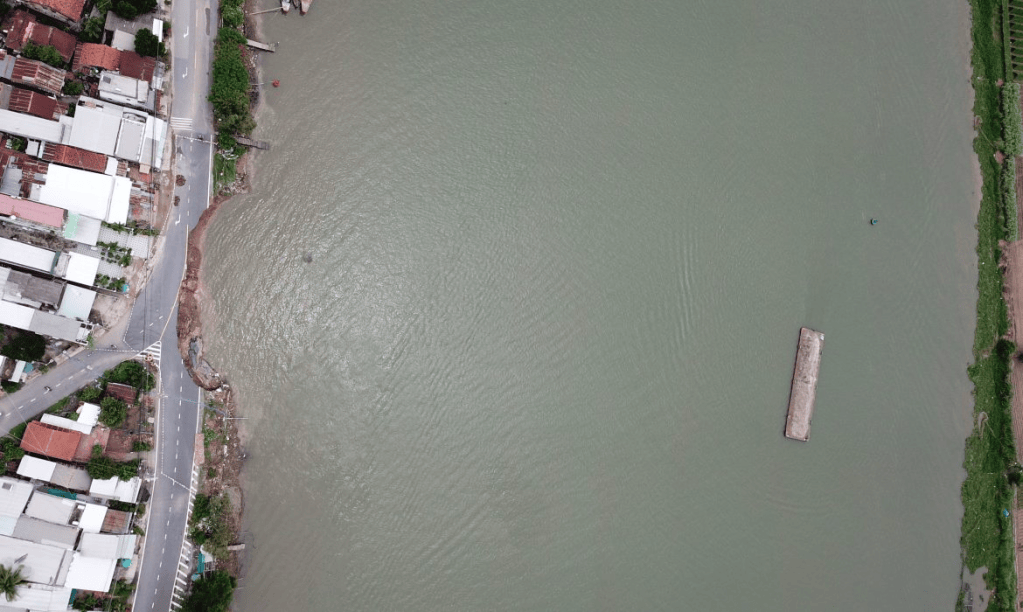
Photo: Cuong Tran
Living in Dong Thap province near the border with Cambodia, a 67-year-old Hai was both a victim of these fatal land erosions in the region. In 2016, while watching the World Cup at midnight, the land beneath him began shaking. What seemed like a distant rumble soon turned into a horrifying roar—the foundation of his home was swallowed in a split second by the river. In the dead of night, Hải was pulled to safety by the passing sand barge and narrowly escaped death.
But the nightmare didn’t stop there. Just 3 years later, the river came for him again. This time, the erosion was far worse; and the house he had just built once again plunged into the river. In a matter of hours, Hải lost everything—all the family’s land, accumulated savings, and his old mother.
What’s more tragic is that Hải’s story is not the only case; thousands of families along the Mekong Delta now face the same devastating fate. In 2022, over 500 erosion hotspots were recorded in the delta, a sharp increase from just 100 spots a decade ago. For Hải and many others, the river that once nourished their lives has become a merciless force of destruction.
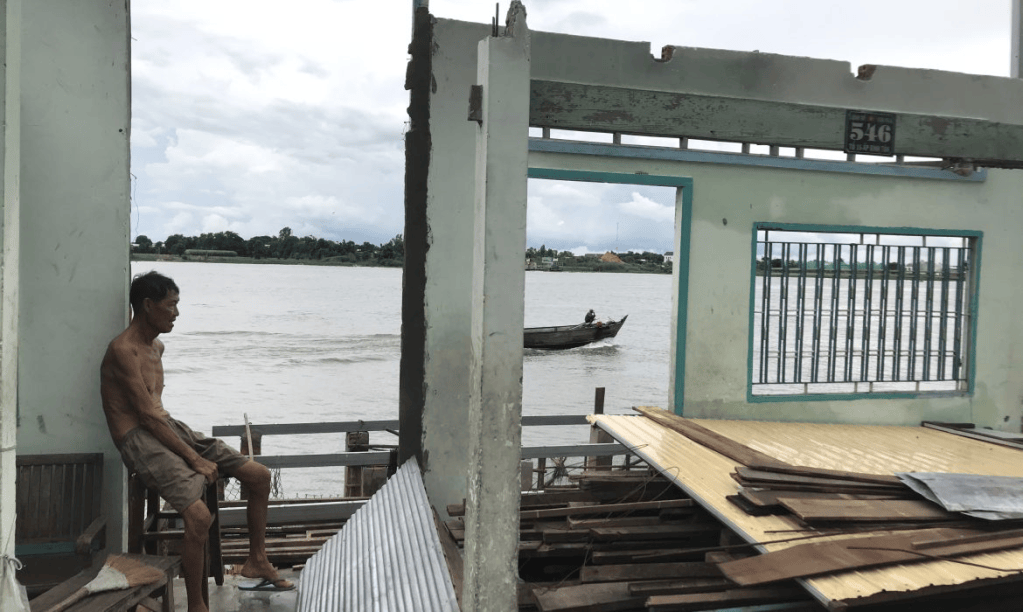
Photo: Cuong Tran
Coastal land erosion is just the initial sign of a deeper crisis. The blockage of valuable upstream sediment by the dams means even less mud is making its way to the river’s end at the ocean. The protective mud and sediment barrier that has safeguarded river freshwater for centuries is thinning, allowing saltwater to penetrate deeper into the mainland. Lack of natural coastal building materials has caused the coastline to erode, and the coastal mangrove forests that were once home to the marine ecosystem are starting to slowly disappear as their fertile ground is lost. According to local authorities, the sea intrudes 15~50 meters inland on average annually, with around 300 hectares of protective forest being washed away into the sea every year.
“Without sediment, the delta dies,” said Dr. Tuấn, Deputy Director of the Climate Change Research Institute at Can Tho University, and scientists predict that the people in the Mekong Delta may only be able to live here for another 80 years. It took thousands of years for the delta to form, but humans only need a few decades to make it shrink.
From the authoritarian intensive agriculture that forced farmers to grow crops with slim profit and the relentless soil exploitation that depleted land fertility, to the curse of droughts, dams and sand mining that has eroded the very foundations of the delta; all of them left people in the Mekong region living in constant fear of losing their homes, their land, and their already fragile livelihoods. If climate change causes sea levels to rise, it will be the last straw that will drown this above-one-meter delta into history.
The delta might disappear, and if so, we will have to rewrite our geography book for our children. Sooner or later, what happens to the Mekong delta is not only a concern for Hanoi, but also a ringing alarm for countries across Asia, Europe and America as the threat to global food security connects us all.
For many, the hope of a better life in the city becomes a desperate escape, yet the migrants have to survive on minimum wages from labor-intensive work, often living in slums with poor living conditions, inadequate healthcare, and exposure to urban flooding. Instead of a promise for stability, these middle-aged migrants face another precarious reality in the city, where they become one of the most marginalized groups being left behind in urban development policies that prioritize economic growth and industrialization over social inclusion.
Behind every grain of rice we eat and take for granted, lie the untold stories of a family struggling to make ends meet. Now, what’s left for the people from the Mekong delta may be nothing more than the haunting memories of home, being young in the countryside and once-vibrant days of farming together with family.
The Mekong delta is exhausted, and so are the farmers.
As the river dries up, so do their hopes.
1NPK fertilizers are three-component fertilizers providing nitrogen (N) for leaf development, phosphorus (P) for strong roots and flowering and potassium (K) for improved crop quality and disease resistance
References:
Hoa-Thi-Minh Nguyen et al. (2017). “The political economy of policy exceptionalism during economic transition: the case of rice policy in Vietnam”. Crawford School Research Papers
https://ideas.repec.org/p/een/crwfrp/1713.html
Nguyen Manh Hai & Theodore Talbot (2014). “The Political Economy of Food Price Policy in Vietnam”. Oxford Academic https://doi.org/10.1093/acprof:oso/9780198718574.003.0015
Central Intelligence Agency – CIA (1978). “Vietnam: Reconstruction and Postwar Economy”. National Foreign Assessment Center. https://www.cia.gov/readingroom/docs/CIA-RDP80T00702A000400070008-2.pdf
Luu Thanh Duc Hai (2003). “The Organization of the Liberalized Rice Market in Vietnam”. Centre for Development Studies, University of Groningen. https://pure.rug.nl/ws/portalfiles/portal/13174336/thesis.pdf
K. Tsukada. (2011).”Vietnam: Food security in a rice-exporting country”. Economics, Agricultural and Food Sciences. https://cdi.mecon.gob.ar/bases/doc/ide/32-5.pdf
T. Gorman (2023). “The Art of Not Being Freshened: The Everyday Politics of Infrastructure in the Mekong Delta”. Sustainability. https://www.mdpi.com/2071-1050/15/6/5494
Mã Phương (2013). “Lén lút… nuôi tôm làm giàu”. [Secretly… farming shrimp to get rich]. Đồng Khởi. https://baodongkhoi.vn/len-lut-nuoi-tom-lam-giau-03122013-a29379.html
Q. Vinh & M. Thuan (2011). “Đổ xô khoan giếng lấy… nước mặn”. Tuoi Tre https://tuoitre.vn/do-xo-khoan-gieng-lay-nuoc-man-465071.htm
Simon Ross. “Learning from the 2008 food crisis: what happened, lessons learned, and ongoing consequences”. Australia Aid. https://waterpartnership.org.au/news-item/learning-from-the-2008-food-crisis-what-happened-lessons-learned-and-ongoing-consequences/
T. Gorman (2019). “From Food Crisis to Agrarian Crisis? Food Security Strategy and Rural Livelihoods in Vietnam”. Food Anxiety in Globalising Vietnam. https://link.springer.com/chapter/10.1007/978-981-13-0743-0_8
Vietnam News (2016). “Mekong Delta farmers struggling with aftermath of drought, salinity”. https://vietnamnews.vn/society/300002/mekong-delta-farmers-struggling-with-aftermath-of-drought-salinity.html
The World Bank (2017). “Toward Integrated Disaster Risk Management in Vietnam”. https://openknowledge.worldbank.org/server/api/core/bitstreams/b50f7e8b-6417-533b-a8c8-1a7bc8a2c784/content
VCCI & Fulbright (2020). “Annual Economic Report Mekong Delta: Enhancing Competitiveness for Sustainable Development”. https://fsppm.fulbright.edu.vn/download/BCKT-Mekong-Delta-Eng-Final.pdf
Nhung Nguyen (2022). “Climate change and dams force older residents to leave Vietnam’s Mekong Delta”. Dialogue Earth. https://dialogue.earth/en/justice/climate-change-dams-force-migration-older-residents-vietnam-mekong-delta/
Aniruddha Ghosal (2024). “In Vietnam’s Mekong Delta, the lure of moving to the city grows even stronger amid climate shocks”. AP News
Doug Saunders (2023). “The Vietnamese climate trap”. The Globe and Mail. Photography by Goran Tomasevic. https://www.theglobeandmail.com/opinion/article-vietnam-climate-migrants-crisis/
Nhung Nguyen (2023). “Poorest districts worst affected in Ho Chi Minh City floods”. Dialogue Earth.
Bảo Uyên & Nhung Nguyễn (2022). “Những chuyến ly hương của người già Đồng bằng Sông Cửu Long” [The migration journeys of the elderly in the Mekong delta]. Tia Sáng
https://tiasang.com.vn/dien-dan/nhung-chuyen-ly-huong-cua-nguoi-gia-dong-bang-song-cuu-long
Nhung Nguyễn, Bảo Uyên & Cuong Tran (2022). “Đồng bằng sông Cửu Long: Trước nguy cơ dần biến mất” [Mekong delta: On the brink of vanishing]. Tia Sáng
https://tiasang.com.vn/dien-dan/dong-bang-song-cuu-long-truoc-nguy-co-dan-bien-mat/#_edn1
Thu Quỳnh (2024). “Đất lúa Đồng bằng Cửu Long: Từ trù phú đến kiệt quệ ” [The vanishing fertility of Vietnam’s Mekong delta]. Tia Sáng
https://tiasang.com.vn/van-hoa/dat-lua-dong-bang-cuu-long-sau-huyen-thoai-tru-phu-hao-sang
Hoàng Nam & Thu Hằng (2023). “Dòng Mekong giận dữ” [The furious Mekong river]. Vnexpress. https://vnexpress.net/dong-mekong-gian-du-4634044.html
Nhin Tan Thuan (2022). “Data exposes flaws in Mekong Delta resilience plans”. Dialogue Earth. https://dialogue.earth/en/water/data-exposes-flaws-in-mekong-delta-resilience-plans/
Hang Ngo et al. (2022). “Health trade-offs in pursuit of livelihood security: exploring the intersection of climate, migration and health from the perspective of Mekong Delta migrants in Ho Chi Minh City, Vietnam”. Climate & Development, 15(4), 269–279. https://doi.org/10.1080/17565529.2022.2077691
Việt Anh (2022). “Bảo đảm an sinh xã hội cho người cao tuổi” [Ensuring social welfare for the elderly]. Nhân Dân. https://nhandan.vn/bao-dam-an-sinh-xa-hoi-cho-nguoi-cao-tuoi-post703762.html
Vietnam News (2018). “Informal workers wary of opt-in social insurance”. https://vietnamnews.vn/society/468038/informal-workers-wary-of-opt-in-social-insurance.html
K. Thach et al. (2023). “Effect of saline intrusion on rice production in the Mekong River Delta”. Cell Press. https://www.sciencedirect.com/science/article/pii/S2405844023075758
Ray Yeh (2017). “Vietnam’s ticking time-bomb of elderly poverty”. CNA https://www.channelnewsasia.com/cna-insider/vietnams-ticking-time-bomb-elderly-poverty-1022431
GSO (2016). “Statistical Yearbook of Vietnam 2015”. https://www.gso.gov.vn/du-lieu-va-so-lieu-thong-ke/2016/06/nien-giam-thong-ke-2015/
C.T. Hoanh et al. (2003). “Livelihood impacts of water policy changes: evidence from a coastal area of the Mekong river delta”. Water Policy. https://doi.org/10.2166/wp.2003.0030
Thong Tran et al. (2022). “Political ecology of freshening the Mekong’s coastal delta: narratives of place-based land-use dynamics”. Journal of Land Use Science https://www.tandfonline.com/doi/full/10.1080/1747423X.2022.2126907
Thong Tran & Jamie Pittock. (2024). “When water policies derail livelihood aspirations: farmers’ agency in everyday politics in the Vietnamese Mekong Delta”. Environmental Sociology https://doi.org/10.1080/23251042.2024.2323601
Son Tung (2014). “Bến Tre: Bình Đại tập trung xử lý các trường hợp đào ao, nuôi tôm ngoài vùng quy hoạch” [Managing unauthorized pond excavation and shrimp farming]. Department of Agriculture of Ben Tre. https://tepbac.com/tin-tuc/full/ben-tre-binh-dai-tap-trung-xu-ly-cac-truong-hop-dao-ao-nuoi-tom-ngoai-vung-qui-hoach-11357.html
Ole Bruun (2020). “Environmental Protection in the Hands of the State: Authoritarian Environmentalism and Popular Perceptions in Vietnam”. The Journal of Environment & Development https://doi.org/10.1177/1070496520905625
Trung Dang (2018). “Vietnam’s Post-1975 Agrarian Reforms How local politics derailed socialist agriculture in southern Vietnam”. ANU Press. https://press.anu.edu.au/publications/series/vietnam/vietnam%E2%80%99s-post-1975-agrarian-reforms
Stephan Ortmann (2017). “Environmental Governance in Vietnam: Institutional Reforms and Failures”. Palgrave Macmillan Cham. https://link.springer.com/book/10.1007/978-3-319-49760-0
The Mekong River Commission (2019). “Summary: State of the Basin Report 2018”. https://www.mrcmekong.org/wp-content/uploads/2024/08/SOBR-Summary-06Feb2020.pdf
World Bank (2022). “Spearheading Vietnam’s Green Agricultural Transformation: Moving to low-carbon rice”. Agriculture and Food Global Practice. https://documents1.worldbank.org/curated/en/099735109222222315/pdf/P17448205335130730bb7e0a6e231e1f667.pdf
Phong et al. “Alternatives for reducing highly hazardous pesticides in rice production: case of An Giang province, Vietnam”. International Pollutants Elimination Network (IPEN)
https://ipen.org/sites/default/files/documents/rcrd_final_report_07172021.pdf
World Bank (2017). “An Overview of Agricultural Pollution in Vietnam: The Crops Sector 2017”. https://documents1.worldbank.org/curated/en/988621516787454307/pdf/122934-WP-P153343-PUBLIC-Vietnam-crops-ENG.pdf
Oxfam (2019). “Unfair Harvest: The state of rice in Asia”. https://oxfamilibrary.openrepository.com/bitstream/handle/10546/620646/bp-unfair-harvest-rice-asia-200319-en.pdf
S. Yuan et al. (2022). “Southeast Asia must narrow down the yield gap to continue to be a major rice bowl”. Nature Food. https://www.nature.com/articles/s43016-022-00477-z
Lang Son Statistical Office (2024). “Phân tích các yếu tố ảnh hưởng tới sản xuất lúa bền vững giai đoạn 2016-2021” [Analyzing factors affecting sustainable rice production in 2016-2021] https://cucthongkelangson.gov.vn/nghien-cuu-trao-doi/phan-tich-cac-yeu-to-anh-huong-toi-san-xuat-lua-ben-vung-giai-doan-2016-2021-394.html
David Pimentel (1995). “Amounts of pesticides reaching target pests: Environmental impacts and ethics”. Journal of Agricultural and Environmental Ethics. https://link.springer.com/article/10.1007/BF02286399
K. Anh (2024). “About 1.58 million households live under the poverty line in Vietnam”. VN Government News https://en.baochinhphu.vn/about-158-million-households-live-under-poverty-line-in-viet-nam-report-111240221164312409.htm
Thang et al. (2013). “Who has benefited from high rice prices in Vietnam?”. Oxfam. https://s3.amazonaws.com/oxfam-us/www/static/media/files/who-benefits-rice-prices-vietnam-full-20131017.pdf
Jean-Paul Bravard et al. (2013). “Geography of Sand and Gravel Mining in the Lower Mekong River”. EchoGéo. https://doi.org/10.4000/echogeo.13659
UNDP (2014). “Migration, Resettlement and Climate Change in Viet Nam”. https://www.undp.org/sites/g/files/zskgke326/files/migration/vn/Migration-and-climate-change_BW.pdf
Michael Tatarski (2021). “As the Mekong delta washes away, homes and highways are being lost”. Dialogue Earth. https://dialogue.earth/en/water/as-mekong-washes-away-homes-highways-lost/
Dinh Tuyen (2022). “Cát nạo lên, tiền đổ xuống”. Thanh Nien. https://thanhnien.vn/cat-nao-len-tien-do-xuong-ky-1-xung-dot-cat-sat-lo-1851451832.htm
Dinh Tuyen (2023). “Mekong Delta pays a high price from sand mining”. Mekong Eye. https://www.mekongeye.com/2023/05/01/mekong-delta-sand-mining
Mekong Delta Programme Assistant-MDPA. (2004). “Mekong Delta Poverty Analysis”. Australia Gov. https://www.dfat.gov.au/sites/default/files/mekong_poverty_report_04.pdf
FAOSTAT. “Crops and livestock products”. https://www.fao.org/faostat/en/#data/QCL
Reuters (2011). “Factbox: 2008 food price crisis — what caused it?” https://www.reuters.com/article/business/energy/factbox-2008-food-price-crisis-what-caused-it-idUSTRE7590IJ/
Thanh Nguyen (2020). “’Xóm ve chai Sài Gòn cuối năm: Nhà trọ ‘ổ chuột’ ngộp thở, tiền đâu tiêu tết?”. Thanh Nien. https://vnexpress.net/cuoc-song-trong-khu-o-chuot-o-sai-gon-3501843.html
Hong Lam (2023). “Người dân TP.HCM vật lộn với nước ngập do triều cường”. Nguoi Dua Tin. https://www.nguoiduatin.vn/nguoi-dan-tphcm-vat-lon-voi-nuoc-ngap-do-trieu-cuong-dang-cao-204633378.htm

